Showing posts with label Charles Hedrick. Show all posts

Thursday, November 6, 2025

Some Personal Perspectives on Religion

This essay describes a few practical guidelines for engaging religious traditions that have evolved from my personal experience and pondering. So far as I know they are not yet writ in any book; they are personal insights to which I have come through the years. I consider them to be truisms1 for me in the practice and the study of religions. They are simply commonsense observations of which it is easy to lose sight, particularly in the practice of religion.

What is true in religion depends on whom you ask. There is no ultimate religious truth, but all people hold religious views as seem right to them. Religious truths are not verifiable and that is religion’s Achilles heel, a fact leading to competing religious truths.

Religious faith cannot reasonably demand that I believe whatever I find to be patently false or illogical. Actually, religion does make such truth claims, but, if I think about it, I am under no obligation to believe what I am told, if I find it to be incredulous.

I have discovered through the years that I have no independent knowledge of Gods, spirits, or other supernatural “entities.” I only know what I have read, what others have told me and what I have worked out for myself through my own ponderings. In general, religious professionals are too partisan, in favor of their own set of beliefs, to be trusted with giving unbiased and objective answers to questions about religion. They give answers based on the perspectives of their own personal faith.

I cannot read the minds of those closest to me; so, I never know what others are thinking; even if they tell me what they think, I have no way to verify it. The same is true of literary characters in a narrative. When a reader is told by the narrator what is going on in the mind of a character that is the author putting thoughts in the minds of his characters. In short, do not confuse the literary character of a gospel, for example, with the actual historical figure on which the literary character is based, for literary characters in a narrative are always inventions of authors.

Many believe the Bible to be a Holy collection of texts, divinely inspired. That idea cannot be proven in whole or in part. It is an opinion. What can be proven is that the Bible owes its existence to human ingenuity and labor. The role human beings played in creating the Bible is easily demonstrated. Human beings authored the ancient manuscripts that comprise the Bible. Others gathered them from the literary stream of Western civilization into collections. Scholars (called text critics) decide what the words of your Bible probably originally read from among the ancient copies of manuscripts. And human beings translate these ancient texts into modern languages. Text Critics and translators do not always agree. Hence various translations of the Bible do not agree in all particulars.

Charles W. Hedrick
Professor Emeritus
Missouri State University

1Truism: “a statement, the truth of which is obvious or well-known, commonplace.” Webster’s New World College Dictionary (4th ed., 2002), under “truism.”

Wednesday, October 1, 2025

Parenthetical Statements in Mark

The ancient Greeks did not punctuate their literature by using two curved half-circle marks known from the sixteenth century as parentheses, although they did write what we today call parenthetical statements that jump off the page screaming “additions to the sentence” for the careful reader.1 Here is an example of a parenthetical statement in Mark 3:30, for which the translators do not provide parenthesis: “because they said he has an unclean spirit.” The phrase explains why Jesus said what he did in 3:28–29. One translation (NRSV) set the phrase off from verse 30 by a dash; another translation (REB) turned the phrase into a complete sentence (adding words not present in the Greek): “He said this because they had declared he was possessed by an unclean spirit.”

            In other cases, translators use parentheses to set off the parenthetical phrase/sentence. The word parenthesis is Greek (parenthesis), which translated means “putting in beside”; that is, adding something additional to the sentence. The “something additional” is extraneous and always subordinate to the main statement.2 In the Gospel of Mark, however, they also have the character of an explanation. In Mark 3:30 the parenthetical statement explains why Jesus said what he did: his interlocuters had accused him of being spirit possessed, and that is what prompted his response in Mark 3:28-29.3

            There are several other instances of parenthetical statements in Mark, or at least some translators think so: 2:10–11; 5:42; 7:3–4; 7:11; 7:19; 13:14; 15:22; 15:34. Modern translators4 use parentheses or dashes to designate the statement as parenthetical. In some cases, however, they do not even acknowledge its parenthetical character (for example, Mark 15:34, which is exactly like Mark 15:22). And in some cases, they seem to skip over parenthetical statements (for example, Mark 16:4: which reads: “for it was very large”).

            Readers will remember that ancient scribes in ancient Greek manuscripts did not separate words from one another. Here is how my last statement would have appeared in an ancient Greek manuscript: greekmanuscriptsdidnotseparatewordsfromoneanother

They did not use punctuation marks, except in rare cases. All of that is supplied by the modern text critics, translators, and editors.5

            Given the propensity of ancient scribes to introduce new readings into ancient Greek manuscripts,6 one wonders if some of these parenthetical statements in Mark might be marginal notes made by ancient scribes that eventually made their way into the body of the text during the first and second centuries, a period for which we have virtually no ancient manuscripts preserved.7

Charles W. Hedrick
Professor Emeritus
Missouri State University

1Britannica, *“Parenthesis, grammar,” https://britannica.com/topic/parenthesis

2J. A. Cuddon, Literary Terms and Literary Theory (3rd ed.; Penguin, 1998), 639.

3There are a great number of such statements in John. See C. W. Hedrick, “Authorial Presence and Narrator in John. Commentary and Story,” in Gospel Origins and Christian Beginnings, 74–93 (edited by James Goehring, et al.; Sonoma, CA: Polebridge Press, 1990).

4The two translations I am using for this essay are NRSV, New Revised Standard Version and REB, Revised English Bible.

5C. W, Hedrick, Wry Guy Blog. ”The Lowly Punctuation Mark in the New Testament.”

http://blog.charleshedrick.com/search?q=lowly+punctuation+mark

6For example, Mark 9:44 and 46 are added to the text of Mark. These two verses repeat Mark 9:48 and do not appear in early manuscripts of Mark. Bruce Metzger, A Textual Commentary on the Greek New Testament (2nd ed.; United Bible Societies,1994), 86–87.

7See the dates given in the back (pages 792–819) of the 28th revised edition of the Nestle, Aland, Novum Testamentum Graece (Greek-English New Testament).

Sunday, June 25, 2023

An Early Christian Slogan?

There is a pithy statement in 1 Tim 2:5-6, written in terse prose omitting certain verbal forms that would help with the clarity of the piece, were they present. It is a concise statement of a slogan-like character.1 Line 4 has the character of a “tag line,” possibly functioning as a title. Likely for these reasons and the fact that the unit appears formulaic, the editors of the Nestle-Aland critical Greek text of the New Testament (NT) chose to print it in a structured format, a printing not generally followed by English translators of the NT:2

For one God

and one mediator of God and humanity

a human being, Lord Anointed Jesus

the one giving himself a ransom for all

the testimony at the right time

There are six other narrative units in the pastoral letters3 published by the Nestle-Aland Greek text in the same stylized manner.4 English Bible translators print some of these in a formulaic manner.

            The narrative unit 1 Tim 2:5-6 is a traditional piece, likely liturgical. It is tied loosely to the surrounding context and hence was likely not composed by the author of First Timothy. It was inserted at this point to support the author’s statement that God “desires all people to be saved.”5

Line 1: taking the word “one” (εις) as the predicate, the translation should be rendered as “God is one” (Rom 3:30; 1 Cor 8:6; Eph 4:5-6), rather than “there is one God,” as modern translators generally render it.6

Lines 2-3: These two lines comprise one thought. A mediator is one who mediates or arbitrates between two parties. That is to say the mediator brings about at-one-ment between two parties. There is no description given as to how the mediation occurs. The appellation “Christ” signals not divinity necessarily but rather that Jesus is “the Anointed of God.” (χριστος=Christ/Messiah=Anointed). The slogan uses the general term for human beings, or people (ανθρωπος). The appellation “lord” is a term used in ancient texts of a person who commands respect or exercises authority. In Hebrew Bible it is used as a substitute for the personal name of God, Yahweh. As applied to Jesus, it is not necessarily a term of divinity. “Giving himself” (stated again in Titus 2:14) is not the same thing as “giving his life” (as it appears in Mark 10:45 and Matt 20:28); compare 2 Cor 8:5 where it is said of the Corinthians that “they first gave their own selves” (see similar statements at 2 Tim 2:15; Rom 6:13). The lack of specificity as to how he gave himself is surprising. The word “ransom” (αντιλυτρον) immediately brings to mind the crucifixion (it is λυτρον in Mark 10:45 and Matt 20:28), but that is not the only way in the NT Jesus is said to have offered himself. In Heb 2:10 Jesus was the pioneer of a certain kind of faith. By being perfected through his own suffering, his own faith (Gal 2:16) established the way of faith for others to follow. The “price of their release” (ransom) was his suffering for his own perfecting; that is, it was not “in our behalf.”7 “Ransom” in Heb 2:10 (αντιλυτρον) in the NT appears only in 1 Tim 2:6, and is a word otherwise only attested in the post NT period.8

Line 4: It is unclear whether the “tag line” was composed by the author of First Timothy or if it is part of the liturgical quotation. “At the proper time” (also in Tit 1:3) in 1 Clem 20:4 refers to the processes of nature.

Evaluation: This liturgical statement is interesting for its lack of detail in the language describing Christ’s role in redemption; compare 2 Tim 1:9-10; Titus 3:4-7; Phil 2:6-11; 1 Pet 2:21-25. The stripped-down statement in 1 Tim 2:5-6 fails to mention his suffering and death in our behalf on the cross and his resurrection. The oneness of God and Jesus performing the work of redemption as a human being reads today like an anti-trinitarian formula. Compare, for example, the detail in Paul’s statement in 1 Cor 15:3-4: I have delivered to you what I also received:

That Christ died for our sins, according to the scriptures;

And that he was buried;

And that he was raised on the third day according to the scriptures;

And that he appeared to Cephas, then to the Twelve.

To consider 1 Tim 2:5-6 “Christian orthodoxy,” one must make a lot of assumptions.

Charles W. Hedrick
Professor Emeritus
Missouri State University

1https://en.wikipedia.org/wiki/Slogan#:~:text=A%20slogan%20is%20a%20memorable,a%20more%20defined%20target%20group

https://en.wikipedia.org/wiki/Hendiatris

2Out of the fourteen English translations of the New Testament on my shelf, only the following render 1 Tim 2:5-6 in a formulaic manner: Holman, New American, New Revised Standard, and Ehrman. All fourteen, however, with the exception of the King James, render 1 Tim 3:16b in a formulaic way.

3The Pastoral Epistles are 1, 2 Timothy, and Titus.

41 Tim 3:16b, 6:11-12, 6:15b-16; 2 Tim 1:9-10, 2:11b-13; Titus 3:4-7.

5Martin Dibelius, The Pastoral Epistles (Hans Conzelmann, ed. of the German edition; Philip Buttolph and Adela Yarbo, trans.; Helmut Koester, ed. of English edition. Hermeneia: Fortress: Philadelphia), 41-43.

6Dibelius, Pastoral Epistles, 41, note 38. For an adjectival predicate: H. W. Smyth, Greek Grammar, §910b, 944-48; Blass, Debrunner, Funk, A Greek Grammar of the New Testament, §270 (1); 127-28. Dibelius (p. 35) renders the expression “God is one.” Dibelius, Die Pastoral Briefe (Handbuch zum Neuen Testament 13; 2nd.rev. ed.; Tϋbingen: J.C.B. Mohr (Paul Siebeck), 26.

7See Hedrick, “On Calling Jesus my Brother,” March 4, 2021 and “How is Jesus the Son of God,” March 22, 2021: http://blog.charleshedrick.com/2021/03/

8F. Bϋchsel, “λυτρον,” in Theological Dictionary of the New Testament, 4.349.

Tuesday, May 18, 2021

Have you ever Doubted your Faith?

Someone asked me recently: have you ever doubted your faith? The question itself is interesting as a question. For one reason, it seems to be lacking a prepositional phrase specifying the object of faith. For example, have you ever doubted your faith in God, Jesus, the Holy Spirit, or the Bible? Or perhaps the questioner intended that the word "faith" in the question evoke the entire spectrum of my religious beliefs. Or perhaps the question is more secular and the questioner was asking whether I have ever doubted faith in friends, family, or country, and in this secular form it has the general thrust of have I ever doubted the confidence I placed in something that I believe to be certain, like gravity, for example. If all these observations are possibilities, then I must refine the question and pick the subject that is most interesting to me.

Here is the question I choose to address: have I ever doubted aspects of my personal religious faith? The short answer is yes, and I suspect that every one of us has moments of doubt about aspects of religious belief. At least I hope so. From my perspective doubting something you think is certain is a positive ability, not a liability. Doubt is a warning mechanism of the mind that can lead to a correction of misplaced confidence.

Like everyone, my personal religious faith has never been static. It began with the child's prayer I was taught, "now I lay me down to sleep; I pray the Lord my soul to keep; if I should die before I wake, I pray the Lord my soul to take." But through the years it has become more sophisticated, logical, and rational with education, as my understanding of life and my place in the cosmos evolved. My faith began with what I was taught in a Southern Baptist Sunday School in the Mississippi Delta of the 40s and 50s. Hence, it was traditional and conservative. Since childhood, however, my faith has been a thing in process, shedding childish ideas and developing in, what I regard as more mature and philosophical ways. There is a statement attributed to the Apostle Paul (that he likely did not compose), which best characterizes the development and remaindering of the faith of my childhood: "When I was a child, I spoke like a child, I reasoned like a child; when I became an adult, I put an end to childish ways" (1 Cor 13:11 NRSV). Doubt has played a major role in developing and remaindering my religious faith. A major premise for me has been the following: faith may not require me to believe something I find to be patently false or impossible given the world as I experience it.

Briefly here are three examples of where this process has brought me. God, if God there be, is spirit and does not exist in the sense that we normally use the word "exist." As spirit, God is not an entity that occupies space and time, as we human beings do. God, as understood by human beings, appears to be an invention of the human mind, whose character and nature change with the confessions of each religious group and individual. God does not correspond exactly to any of the many ideations of the human mind that claim to describe God. And if God does correspond exactly to one of these ideations, how could we tell? The Jewish and Christian Bibles present at least three different concepts of God. Thus, God, if God there be, is shrouded in mystery. There can be no direct knowledge of God. We learn about God from what others tell us, from the study of religions, and from those who claim to have experienced God, but all these sources offer us radically conflicting opinions.1

Whatever else he may have been, Jesus was certainly regarded as a Judean sage, thaumaturge, and healer, or at least the author of the earliest canonical Gospel, Mark, regarded him as such, and those features are reproduced in the other three canonical gospels. His popularity with the masses and laxity in following the traditions of the elders ran him afoul of the Judean religious leaders. He was arrested, found guilty of blasphemy, and eventually crucified for political reasons by Roman authority. The early followers of Jesus, however, believed him to be much more, and used grandiose titles to describe him: God (John 20:28), son of God, Lord, the Anointed of the Lord (Christ), son of David, King of Israel. These honors are not verifiable by naked eye but rather are verified only through the eyes of faith. These days I prefer to think of Jesus as my brother in faith.

In Acts and Hebrews, Jesus is portrayed as a pioneer (archēgos), perfected through his own sufferings and his suffering qualified him to lead the way to glory for many other sons of God (Heb 2:10; 12:2). In this way Jesus, the Judean sage, became the firstborn among many brothers (Rom 8:29). My view of Jesus may make me appear as an apostate or certainly a heretic (they are not the same thing2), since it by-passes divinity for humanity as a classification for Jesus. There were various views about the nature of Jesus in antiquity, and it depended on whom you asked as to whether Jesus was divine. People holding a view different than the so-called orthodox view must nevertheless be classified as being in the stream of Christian history.3 Whatever group was dominant became the judge of what was orthodox.

In church I was never taught data about the Bible except for the most obvious information. Generally, I was taught to regard the Bible as "God-breathed"4 and to pattern my life on its precepts. My views have changed. I no longer think of the Bible as a "Holy Book" but as a collection of texts that reflect the evolution of the faith of two religious communities, Jewish and Christian. There are currently three versions of the Bible: the Jewish Bible, the Protestant Bible, and the Catholic Bible. Their contents are not the same. The Protestant Bible with which I grew up uses the Jewish Bible, which it regards as Old covenant books; to these texts were added certain new-covenant writings, twenty-seven other texts (the New Testament), which were assembled as a collection by the fourth century common era and added to the Jewish Bible. By the fourth century followers of Jesus regarded all these books in Hebrew, Aramaic, and Greek as in some sense "inspired" by God. Modern Christians transfer that high value to its translation into modern languages, forgetting that no translation is an exact reproduction of the original.

I have only touched the surface of my view of the Bible today as compared to where I began. My hasty summary nevertheless shows that if the Bible is "inspired" by God (a view that cannot be proven), it is also to be regarded as a human product. Human beings collected and canonized the writings, and text critics established what they regard as the original wording of the texts and they still debate what words should appear as the original wording.5

I have learned to live with the evident lack of certainty in matters of religious faith. The major difficulty with religion is that too many are absolutely certain that their religious faith is the true faith.

Charles W. Hedrick
Professor Emeritus
Missouri State University

1C. W. Hedrick, Unmasking Biblical Faiths (Eugene, OR: Cascade, 2019), 168-70 and in particular: "Out of the Enchanted Forest. Christian Faith in an Age of Reason" pages 13-24 in When Faith Meets Reason (Santa Rosa, CA: Polebridge, 2008).

2Hedrick, "How do I Describe Myself," Wry Thoughts about Religion, Friday, February 15, 2019: http://blog.charleshedrick.com/2019/02/how-do-i-describe-myself.html.

3Hedrick, "Is Belief in the Divinity of Jesus Essential to Being Christian," Unmasking Biblical Faiths, 221-233.

4But this could only refer to the Jewish Scriptures in Greek (the Septuagint) for the New Testament had not yet been collected and given the status of "inspired Scripture."

5Hedrick, Unmasking Biblical Faiths, 87-102.

Monday, September 21, 2020

We are Citizen-Soldiers, Mr. Trump!*

We consider ourselves winners rather than “losers” and “suckers.”2 Although I will admit that from the perspective of a man alleged to have inherited millions from his father, I might have looked like a loser in 1953. After one year at a Baptist college in Mississippi,3 I enlisted in the U. S. Army in May of 1953 as a Pvt E-1 during the hostilities of the Korean Conflict. Some months later (July 1953), while I was in Basic Training at Ft. Jackson, South Carolina, military leaders signed a “cease-fire” order at Panmunjom. A few months later as the honor graduate of an Army Leadership School at Ft Lee, Virginia, I was given my choice of area of assignment. I chose the European Theater, where I served the rest of my initial three years of military obligation in Germany at Headquarters Southern Area Command (with five years reserve duty remaining to my enlistment). The rest of my class was assigned to the Far East Command (Korea). I returned from Europe in 1956 with the GI Bill in hand and a wife (now of 65 years), who was pregnant with our first child and we headed back to college. Supported by the GI Bill I completed college in 1958 (B. A.) and Theological Seminary in 1962 (B. D.) in California. While serving as pastor of First Baptist Church, Needles, California (1962-65), I applied for and received a direct commission from the President as a Reserve Commissioned Officer (Chaplain) on the 8th of September 1964. Why did I join the Army again? I wanted to serve my country—and besides I liked the professionalism and camaraderie of military life.

Volunteers who choose to continue their military service as soldiers in the active reserve force think of themselves as citizen-soldiers. They work in their civilian occupations or careers, but one weekend each month they put on the uniform and train in their MOS.4 At least two weeks every year they serve a tour of active duty working at the military job they trained to do. Citizen-soldiers are required to take additional time away from civilian jobs to go through military schools to qualify for promotion and retention in the service, which again takes them away from family and civilian jobs. In addition, they may also be called up to active duty for special tours anywhere in the world where the military needs their skills. They are paid commensurate with their rank and if they elect to continue this demanding schedule for at least 20 years, upon retirement they are paid a retirement stipend, receive medical coverage for life for them and their spouse, and all the other benefits that active duty soldiers receive. In the event of a national emergency, like the Roman farmer, Cincinnatus,5 they are subject to “activation” to serve wherever the military assigns them for the duration of the war or the duration of the emergency. I was activated for Operation Desert Storm in 1991 and served 7 months as a Colonel (Chaplain) in the Personnel Office of the Chief of Chaplains at the Pentagon (Washington), to which I was assigned as a Mobilization Designee in reserve status. This meant leaving my family and civilian occupation abruptly in the middle of the academic year. I was a tenured faculty member at Missouri State University, and the university had to cover my classes at the last moment. My salary and benefits at the university stopped and I and my family were completely dependent on the Army for salary and medical benefits. My service to the country came at the cost of a disruption to my academic career and to my family (I left behind a wife with a severely broken ankle). When hostilities began, I had no idea how long the war and separation from home would last.

Citizen-soldiers are members of the National Guard and the U. S. Military Reserve that serve as a ready reserve force for the U. S. Military in times of National emergency.6 To understand why they do it, Mr. Trump, one must first understand patriotism. I have found that career soldiers, both Regulars and Reserve, are motivated to choose a profession of arms out of a sense of patriotism; they continue patriotically serving their country from a sense of professionalism. Still don’t get it? Ask a soldier!

Charles W. Hedrick
Chaplain (Colonel), USAR, retired

*This essay is one of those rare occasions where a current issue has motivated me to stray into politics. It has nothing to do with religion except that the author is a retired U. S. Army Chaplain with thirty years’ service.

2It has been confirmed by several different media outlets that President Trump referred to members of the military who are killed in the course of their service as “losers” and “suckers.” This is the article that started the flap: https://www.theatlantic.com/politics/archive/2020/09/trump-americans-who-died-at-war-are-losers-and-suckers/615997/

3Since I had no financial resources to continue my education the next fall, I enlisted in the Army to secure the educational benefits of the GI Bill—an excellent choice for me.

4MOS, Military Occupational Specialty.

5Cincinnatus was a Roman patrician, statesman, and military leader of the early Roman Republic who was called from his plow to serve the Roman State. At the end of the crisis he returned to his plow.

6https://legal-dictionary.thefreedictionary.com/Citizen-soldier.

Monday, July 29, 2019

Judging Others

Jesus said, or at least two gospels attribute the saying to him: “Judge not that you be not judged” (Matt 7:1; Luke 6:37). The saying is a Q tradition, but it may have been attributed to Jesus in error by the later Christian community. Paul (Rom 2:1) and James (4:12) employ the idea of not judging others without making any reference to Jesus, and the idea of not judging others is found in rabbinic traditions. Hence, the concept may likely have been derived from Israelite and/or Christian wisdom. The Jesus Seminar voted that it was not a saying of Jesus.1 On the other hand if Jesus did prohibit judging others, as the writers of the gospels report, then he failed to follow his own advice, for the gospels depict him judging the intentions of others rather harshly. For example:

But woe to you scribes and Pharisees, hypocrites! Because you shut the kingdom of heaven against people; for you neither enter yourselves, nor allow those who would enter to go in (Matt 23:13; compare also: Matt 16:6, 12; 23:2-7; 23:13-33; Mark 8:15; Luke 11:39-44; 12:1).

The verse quoted above (Matt 23:13) was printed in grey in the Five Gospels, meaning that the saying itself should likely not be included in a databank of Jesus sayings, but one nevertheless might make use of some of the content for determining who Jesus was. Perhaps the most graphic saying as to how the gospel writers thought Jesus regarded the Pharisees is the harsh depiction of the Pharisee in the story of the Pharisee and the toll collector (Luke 18:10-14).2

            Making moral judgments about others is something that a wise person must inevitably do to survive in life. For example, even Jesus was thought to have denied that Caesar’s government was supported by God (Mark 12:17)3 and he insulted King Herod (Luke 13:32).4 Judging others is something we will all do living in a society that has not succeeded in eradicating the presence of grifters, “confidence men,” charlatans, cheats, swindlers, dishonest businessmen, scammers, “snake oil salesmen," and others who prey on the gullible and unsuspecting for whatever reason. I define “sitting in judgment of others” as evaluating their skill, competence, reputation, character, and honesty.5 We are particularly called upon to judge those who run for political office, but also used car salespersons, grocers (did they set their scales a bit too heavy, perhaps?), physicians, attorneys, baby sitters and even ministers (you will recall the numerous cases of child abuse involving Catholic priests, among others).

            In our society one cannot take everyone at face value, but is required to dig deeper and even question the motives of others. For example, one must weigh this question upon receiving a solicitation for money on the phone: is the person on the other end of the line being duplicitous or honest? Can I trust the attorney I have consulted about a legal matter to rigorously represent my interests in court? Can I simply trust that a particular charity soliciting funds from me will actually do what is promised or should I first judge their record and validate how they spend the money? All of these in my view are moral issues, and I have a moral obligation to act with integrity in my engagement with society.

            It would be nice if we lived in a perfect world, but alas we do not. The world is a threatening place. Even Jesus said: “be as wise as serpents and innocent as doves” (Matt 10:16 RSV; my translation: “be as sly as snakes and simple as pigeons”; compare Gos. Thom. 39b).6

Charles W. Hedrick
Professor Emeritus
Missouri State University

1See Funk and Hoover, Five Gospels, 153-54.
2This saying is printed in the Five Gospels in pink (p. 369), meaning that Jesus probably said something like this statement.
3As Paul did for example (Rom 13:1-7).
4Funk and Hoover, Five Gospels, 348-49. Luke 13:32 is colored grey; the Fellows found it plausible, however, that Jesus “may well have said something of the sort found in this verse.”
5I never worry with the intentions of others, for we can never know another’s intentions even should they tell us what their intentions are. Judging someone’s intentions is all guess work.
6Hedrick, Many Things in Parables; see pages vii-1x, for a discussion of the saying. The saying is colored in Pink in the Five Gospels, p. 169.

Sunday, January 6, 2019

What happens to an aging Academic and Religion Scholar?

Academics are not necessarily scholars and scholars are not necessarily academics: Academics basically pass on a body of knowledge; scholars, on the other hand, aim to modify and/or expand the traditional body of critical knowledge to be passed on to each generation.

If fortunate, s/he gets to retire, but then is faced with “what next?” Perhaps s/he will teach another year or two as a faculty adjunct, attend a few more professional conferences, write another article or two, perhaps post a blog, and then, time running out, write a final book—but what then? Advanced old age, arthritis, aches and pains are fast catching up; imperceptibly s/he slows down, strength is not what it once was, balance is awful. Children want mom and dad nearer to them for their/our sake and that of the grandchildren. S/He resists. But finally faces reality: future days are limited.

            S/He looks around; the family home needs repair and paint, neglected for the pursuit of scholarship (Alles für die Wissenschaft, right? ); dozens of boxes filled with various stages of research, half finished articles, books completed or begun, and forty or fifty years of living in the same location, a scholar’s library of books lining every available wall in the house, its value now diminished in the digital age—but surrender the books? An incredible thought!

            S/He begins dumping boxes of files, resolving only to preserve photographs that may have historical value—professional ideas consigned to the ages in that which s/he has published. Each dumped file a creative process, either completed and published or paused, representing months of work around the world in conferences, museums, libraries, on ancient archaeological sites. Each dumped file is one piece of the movement toward achieving the goal of reducing the carbon footprint and facilitating the move nearer children, but it comes at the cost of obliterating who s/he was: a scholar.

            Unfortunately this scenario, or something similar, is the way of all flesh: you can’t keep things forever, and you cannot take them with you. There is a proverb, probably traditional, that the evangelist John appropriates to conclude Jesus’ address to Peter in John 21:18; the proverb succinctly summarizes the plaintive situation of those of us who live into advanced old age:

When you were young, you dressed yourself and walked where you wished; but when you become old you will stretch out your hands and another will dress you and take you where you do not want to go.

Alas, obsolescence is the way of the world: things eventually wear out, become ineffectual, and pass into oblivion—museums and libraries, on the other hand, are our ways of ensuring that we never completely forget, a way of ensuring immortality for some. Recognizing the way of the world for what it is should bring us neither to the edge of despair nor resigned acceptance, but it should disturb us enough to “rage rage against the dying of the light”—evoking for good or ill lines by Dylan Thomas:

Though wise men at their end know dark is right,
Because their words had forked no lightening they
Do not go gentle into that good night.*

Rather they begin filling new collections of boxes. That is the way of the human spirit.

Charles W. Hedrick
Professor Emeritus
Missouri State University

*Dylan Thomas “Do Not Go Gentle into that Good Night” in The Collected Poems of Dylan Thomas 1934-52 (New York: New Directions, 1957), 128.

Thursday, April 26, 2018

Apostates and Heretics

Recently I had another unsettling conversation in a crowded public space with a now angry man. The conversation was overheard by others, and his ire was directed toward me personally. Several months earlier we had talked about religion in a more amicable way.1 On this most recent occasion, he began, abruptly and rather confrontationally,

"Do you believe in Hell?"

"No."2

"Where do you go to church?"

"First Baptist."

"Is that what they teach you there?"

"No; I assume that virtually all members of my church believe in Hell."

The conversation continued apace and then he left the area, returning momentarily to assert:

"You know what you are? You are an apostate. Do you know what that is?"

"Yes; and you seem a very angry man."

The conversation continued briefly in another room where I told him, "the term 'apostate' is not correct; in the past some have called me 'heretic," which is likely more appropriate." After a moment he said, "The reason you write those newspaper articles is to call attention to yourself."

            Here are the definitions of the terms. Apostasy is "renunciation of a religious faith." With respect to the conversation above the accusation was that I had renounced the Christian faith. There is a passage in the New Testament that describes the circumstance of the one who commits apostasy: Hebrews 6:1-6 (using in Heb 6:6 the Greek word parapesontas, falling away, making a defection). In the view of the author of Hebrews, those who defect from the faith cannot be renewed again to faith. The actual word "apostasy" is used in Acts 21:21, where Paul is accused of teaching apostasia (apostasy, making a defection) from Moses; that is, Paul was accused of teaching that Jews should not circumcise their children and follow other Jewish traditions. It appears also in the deutero-Pauline letter, Second Thessalonians, where the "man of lawlessness" is revealed in the apostasia (the rebellion or defection, 2 Thess 2:3).

Heresy, on the other hand, is "adherence to a religious opinion contrary to church dogma; or dissent or deviation from a dominant theory, opinion or practice." Hence a heretic is "one who dissents from some accepted belief or doctrine." The word "heresy" (αἳρεσις; transliterated hairesis) is translated by the word "sect" in Acts 24:14, "factions" in 1 Cor 11:19,  "party spirit" in Gal 5:20, and "heresies" in 2 Pet 2:1.The word is used to identify various factions in a given religious body, as for example in Acts 26:5 where Paul refers to the Pharisees as "the strictest party of our religion (compare also Acts 5:17; 15:5; 24:5; 28:22). The word "factious" (or it could be translated sectarian) is used to translate the Greek hairetikon in Tit 3:10.

It appears then that heretics are regarded as erring members of the faith community, and apostates, on the other hand, are no longer members of the faith community but have completely given up the faith.

There were in the early period no generally accepted standards for judging Christian beliefs, until in the fourth and fifth centuries one group from among the early competing factions in the Jesus gatherings achieved an ascendency in the ancient world. The ascendant group called themselves "the Orthodox." They adopted a canon (our current Bible more or less3) and creeds (the Apostles Creed and the Nicene Creed4). Then they judged others by the beliefs they developed for their own religious communities, and called those in other Jesus gatherings who had different views, "heretics." Of course those that the Orthodox declared to be heretical had a name for the orthodox—it was "heretic." In the game of right belief and wrong belief with respect to religion, the correct answer depends on whose argument one finds most persuasive.

Charles W. Hedrick
Professor Emeritus
Missouri State University

1 See Hedrick, "Did Jesus Believe in the Christian Hell?" Wry Guy Blog, September 9, 2017.
2 See Hedrick, "Does Hell Exist," Wry Guy Blog, August 29, 2015.
3 See Hedrick, "When did the Bible become the Word of God?" Wry Guy Blog, January 26, 2015.
4 See Bettenson and Maunder, Documents of the Christian Church (3rd ed.; Oxford, 1999), 25-29.

Thursday, April 27, 2017

Will the Jesus Tradition remain Relevant?

A good friend suggested that I owe an explanation to people of progressive religious faith as to why I still concern myself with the Jesus traditions in light of my published views that the Jesus tradition is historically unreliable, and traditional Christianity is based on mythology. He was thinking like a progressive pastor, preacher, and prophet of social justice; I, on the other hand, am a retired academic and a historian of Christian origins. Our perspectives are quite different. Critiquing the Jesus tradition is something I do professionally, and my friend is a practitioner of a new form of traditional faith based on social justice.
 
            The explanation he asked of me is nothing less than describing what the Jesus tradition contributes to contemporary human life; that is, what in the Jesus traditions might be embraced by people of progressive religious faith and what should be consigned to the bulging trash bins of dead religions.  Fortunately he asked me to address the entire spectrum of the Jesus traditions; that is, to address not only what originated with the historical Jesus, but also what others have found of value in the Jesus traditions. In his challenge all of the Jesus tradition is given an equal weight.
 
            Here are two reasons for my continuing interest in the Jesus tradition, and why I think it will continue to remain relevant. These two reasons only scratch the surface. Judging from the pervasive influence of Christianity and the iconic status of the Bible in contemporary American culture, it is obvious that the Jesus traditions remain relevant in 21st century America. Hence, the critical study of the Jesus tradition (what I do) will remain a legitimate public service until it happens that traditional Christianity and the Bible lose their influence in modern society.  For the foreseeable future, however, there remains a need for critics of the Jesus tradition to separate beliefs about Jesus from the probable views of Jesus in order to call into question illegitimate uses of the Jesus tradition.
 
            A second reason relates to early Christian ethical values. Early Christian writers have preserved certain ethical concepts, which have inspired much that is beneficial in Western civilization. One such concept is a liberal humanitarianism grounded in the concept of altruistic and unconditional love, which has embedded itself in Western culture. Altruistic love is an unselfish concern for and devotion to the welfare of others, without regard either for personal benefit or personal cost.
 
            The Jesus traditions have brought over from the ancient Israelite tradition the idea of loving one's neighbor (Lev 19:18; Mark 12:31). In the Israelite tradition the neighbor was not one's fellow human being of whatever ethnic background, but rather one's fellow Israelite (Deut 15:1-3); that is to say, their neighbors were of their own tribe.  Love was also extended to those sojourning among the Israelites; that is to say, to the stranger in their midst (Lev 19:33-34). In the Hebrew Bible love for neighbor appears in Torah as a commandment of God—hence it is a religious ethic of the Israelite community, which through Jesus passed into early Christian communities. Paul, for example, writes:
 
Owe no one anything, except to love one another, for he who loves his neighbor has fulfilled the law. All the commandments are summed up in this sentence: you shall love your neighbor as yourself. Love does no wrong to a neighbor; therefore love is the fulfilling of the law. (Rom 13:8-10)
 
In this statement "neighbor" is not a fellow human being of whatever ethnic background, but rather a religious community ethic—love for your fellow Christian (as in Romans 15:1-2; Gal 5:13-15). Nevertheless, James 2:1-13 does seem to shade over into a universal humanitarian code of care and concern for fellow human beings.
 
            One of the clearest expressions of a kind of secular altruistic love is found 1 Corinthians 13:1-13. Love in this passage does not appear to be a Christian attribute, which is motivated by religious belief and empowered by divine sanction; rather it is a nakedly human quality. There is no mention in this chapter of theology or Christology; neither God nor Christ is mentioned as motivating or enabling the act of loving.
 
            One hard saying unique to Jesus in antiquity unquestionably illustrates an altruistic unconditional love; Jesus said "Love your enemies" (Luke 6:27b; Matt 5:44b). The literary context in which this saying is found struggles against the concept of "loving enemies" by offering lesser actions that involve minimum risk, which can be done without actually expressing concrete love for the enemy. In my view the world would be more impoverished without the concept of unconditional love, and it is precisely the Jesus tradition that has imported this concept into Western culture.
 
Charles W. Hedrick
Professor Emeritus
Missouri State University

Monday, October 31, 2016

A DIVIDED AMERICA

                      A shorter version of this essay appeared in the Springfield News-Leader, October 31, 2016, p. 2C.
 
That America is divided is news to no one—particularly in this divisive Presidential election year (2016). The body politic seems to agree on very little, and our citizenry as a whole seems to have very little in common. I don't usually stumble about in political issues, but since the election this year has been particularly fractious, it set me to thinking about the ethical center of the country. If there is such a center, what might it be?
 
            Our grand experiment in democracy has not united us, as our current incorrigible political discourse attests.  Because America is a nation of immigrants our ethnicity does not unite us—we are, and are destined to remain, a nation of diverse ethnicities with different values and cultural traditions.  Not even our vaunted secular educational system succeeds in uniting us because of homeschooling and private religiously-oriented high schools and colleges. Our religion does not unite us in terms of beliefs and values because the melting pot that is America hasn't worked on religion—we don't even do toleration well.
 
            What we seem to have in common is that we are a secular people—that is, our society for the most part is "rationally organized around impersonal and utilitarian values and patterns and receptive to new traits."
 
            The preamble to the U. S. Constitution is a very hopeful statement of the ideals and intent of the founders of the country. It is a vision of a "shining city on a hill," but the reality is far different. Today we are scarcely a "more perfect union," and cannot even agree on the nature of Justice in the social order. Too often domestic tranquility hinges on the neighborhood in which one lives. Congress bickers, but cannot agree on, how much or how little should be provided for the common defense. We all want for ourselves and our posterity the blessings of liberty, and do not seem bothered that not all citizens fully share in liberty's blessings.
 
            The only thing we seem to agree on is the emphasis in the preamble on promoting the general welfare, as long as the welfare being promoted is mine—and this is my point: we all agree on the utilitarian value that "my welfare" should be promoted; yet we seem unaware that a government formed "of the people, by the people, and for the people" comes at some individual personal cost; put simply: freedom is not completely free.
 
            A representative democracy, and the high ideals of the preamble to the constitution, can only succeed if they aim at working for all citizens, and that means concessions are required on everyone's part. Hence the goal is not "my welfare" but should be "our common welfare." Economic benefits must aim always at providing for the common good. An economic rising tide must "raise the boats of all citizens" to be successful. The traditions and beliefs of a religious majority cannot be mandated so as to compromise the religious traditions of minority groups.  In other words, for a democratic society to function toleration is required. The goal is to achieve the greatest amount of liberty under the law for the greatest number of people.
 
            Politics is the art of the possible, which always involves compromise. Everybody gets a little and gives a little in return. In a democracy the most successful politician is the one skilled at deal making, for s/he moves the country forward.
 
            A wise man once said, "a state divided cannot stand" (Mark 3:24-25). We would do well to heed his caution, and seek common ground.
 
Charles W. Hedrick
Professor Emeritus
Missouri State University

Wednesday, October 26, 2016

Barnes & Noble Book Signing

 Charles W. Hedrick signing books and meeting the public at Barnes and Noble Springfield, Missouri on Saturday 10/22/16. Charlie is chatting with Bill Lord, Chaplain (Colonel) U. S. Army (retired).

Wednesday, July 20, 2016

Parables are not Parabolic Figures; they are Narrative Fictions

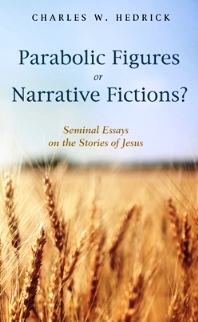
I am delighted to announce that Wipf and Stock, publishers in Eugene, Oregon, has recently published in their selective Cascade Series a new book of mine entitled Parabolic Figures or Narrative Fictions? Seminal Essays on the Stories of Jesus (Eugene OR: Cascade, 2016); the cost is $38.00 from the press. It is available at Amazon, Barnes and Noble, etc. and even in electronic form.
 
            In the book I contend that parables do not teach moral and religious lessons; they are not, in whole or part, theological figures for the church. Rather parables are realistic narrative fictions told to Judean peasants, and like all effective fiction literature the stories are designed to draw auditors (and now readers) into their story worlds where auditors and readers make discoveries about themselves by finding their ideas challenged and subverted—or affirmed, by the stories.
 
            The parables have endings but not final resolutions, because the endings raise new complications for careful readers, which require further resolution.  The narrative contexts and interpretations supplied by the evangelists constitute an attempt by the early church to bring the secular narratives of Jesus under the control of the church's later religious perspectives.  Each narrative represents a fragment of Jesus' secular vision of reality.
 
            As I began this approach to parables over twenty years ago, I found myself moving further outside the mainstream of parables scholarship, both ecclesiastical and critical. I explored a literary approach to the parables in a series of early essays that, among other things, set out what I considered the basic rationale for a literary approach to the parables of Jesus.  These early essays form the central section of the book, published in recently edited form along with previously unpublished critiques of a strictly literary approach to the parables and my response to my critics.*
 
            I have been invited by Barnes and Noble in Springfield, Missouri for a meet-the-public and book signing on October 22, 2016.  If you are in town, drop by and let's chat a bit about parables, my blog, or you could just share a bit of your own thinking with me.  I am always happy to entertain new ideas.
 
What do you think of the parables as stories for a Judean peasant audience?
 
Charles W. Hedrick
Professor Emeritus
Missouri State University
 
*adapted from the back cover of the book; used by permission of Wipf and Stock.

Thursday, December 31, 2015

A New Year’s Introspection

When I was younger, I perceived my future bright with prospects and promise.  On waxing old and being full of days, however, I have discovered my interests now are more about retrospect than prospect.  We elderly live in another country, and even though like Moses we may be permitted to view the prospects of the New Year's promised land (Deuteronomy 34:4), we are fated to remain in the land of Moab, in our own country and time (Deuteronomy 34:5-6).  In the late autumn of life and with the onrush of winter our vengeful enemy, time, has taken a terrible toll: sagging skin, thinning hair, a diminishing of the life force, failing eyesight, lapsing memory, other assorted aches and pains, and physical impairments.  Few of us octogenarians are like Moses, of whom it was fabled: "his eye was not dimmed, nor his natural force abated" (Deuteronomy 34:7). But we elderly have "eternity in our minds" (Ecclesiastes 3:11), and seem to think we should live forever.
 
            I prefer to think of aging and our eventual physical demise as the natural course of things.  A prime axiom of the universe is obsolescence—things just wear out, become obsolete, and disappear.  Or put another way, they die out, and pass out of existence.  We instinctively know it is true—whether of nations, neighborhoods, sump pumps, or, alas, of people.  Such is the way of all life and things in the universe as we know it.
 
            I could, of course, be wrong. Paul turned what in my view is a natural occurrence into a theological dogma.  Based on the Hebrew myth of creation, he argued that because the first human being sinned (Genesis 2:17) the human potential for death entered the world and passed onto all human beings, in that all have sinned (Rom 5:12, 17; 1 Corinthians 15:21).  Apparently Adam's sin even affected the universe, as it too is under bondage to decay (Romans 8:20-23) and obsolescence (1 Corinthians 7:31).  So, in part, Paul and I are of the same mind—except that he thinks theologically, and my statements are made on the basis of observable evidence. It must be said that the universe is expanding at a rapid rate and shows little sign of diminishing energy.
 
The Psalmist seems to regard a limited life span as a natural phenomenon:
 
The years of our life are threescore and ten, or even by reason of strength fourscore; yet their span is but toil and trouble; they are soon gone, and we fly away. (Ps 90:10 RSV)
 
There is no talk here of our lifespan being reduced by God's judgment because of sin.  The situation seems to be that the Psalmist has observed only the natural way of life in the universe. The human lifespan is only so long because of the prime axiom of the universe.  It is likewise the view of Koheleth (Ecclesiastes 1:1), who philosophizes about those things he "has seen under the sun" (Ecclesiastes 1:14; 2:17; 3:16, 22; 4:1, 7; 5:13: 6:1; 7:15; 8:9, 17; 9:11, 13; 10:5).  There is no appeal here to divine revelation, rather Kohleth appeals to human experience in a similar way that proverbs appeal to human wisdom.
 
            For those who have lived into their yellow leaf the New Year is not about resolutions but rather reminiscences.  We in the twilight of life are poised on the threshold of life's greatest adventure, and what matters now is not the coming year and its prospects, but what lies behind along with our regrets and personal satisfactions.  Perhaps that is why I don't have a "bucket list."  These days I think about those things I have left undone, the roads never taken, the questions never asked, the books never read, old friends with whom I have lost contact, the essays never finished.  Have I left a deep enough footprint in the sand that the first high tide will not erase?  I suppose in long term it does not matter. Very few things endure the ravages of time.
 
            Is there a lesson in all this introspection?  In the last chapter of Ecclesiastes (12:1-14) a later editor has concluded: "The end of the matter; all has been heard. Fear God and keep his commandments; for this is the whole duty of man" (Ecclesiastes 12:13 RSV).  I prefer thinking on the views of the principal author of the text: these I regard as the "intellectually honest ponderings of a man who looked at the world primarily from a rational perspective rather than through the eyes of faith. He struggled with the question: what is the point of life—and found no satisfactory answer."  But the point is he continued struggling with the questions, and in the final analysis gave up neither on life nor God.  His struggles with the dichotomy between the answers of traditional religion, and what he sees going on in the world around him have led him to be satisfied with the simple pleasures of life (2:24; 10:19).
 
            So the New Year comes! Yet this first day of a New Year, after all the fuss, is just another day in the succession of many others.  Those of us fortunate enough to see its dawning should rejoice and be glad in it (Ps 118:24).  Koheleth would appreciate that sentiment; he thought of life as a great gift—hope is only for the living.  Or as he put it: "a living dog is better than a dead lion" (Ecclesiastes 9:4).
 
For my tribe, you elderly: may your New Year's Day be full of happy memories that bring smiles to your face, rather than blushes to your cheeks.  For those who are younger: may your new country be full of bright prospects.
 
Charles W. Hedrick
 
Quotation from Hedrick, The Wisdom of Jesus. Between the Sages of Israel and the Apostles of the Church (Cascade, 2014), 72.