Showing posts with label books by Charles W. Hedrick. Show all posts

Thursday, January 4, 2024

Rhythm, Rhyme, and Religion

A Christmas Miracle?

Christmas Day,

In the roadway,

I found a Lincoln cent

That failed to glint,

because it was chocolate brown,

Not copper red, but color of the ground.

“See,” said I, “It’s a penny.”

My daughter agreed with me.

But on coming home

The penny had metamorphosed;

Not a cent, as we supposed.

It was a dime,

Colored by dirt and grime.

Can it really be,

Like a rock into a tree,

That with a little time,

A red cent became a brown dime?

Why not,

I thought.

It happened once before,

In days of yore.

A man became God.

How odd!

For the last several years on my daily walking route of 2.5 miles, I have been writing a hasty rhyme each time I found a coin in order to commemorate the finding. I recently self-published a modest volume of these rhymes for the family.* They are not serious poetry, but aim at being whimsical. The above rhyme, however, neither made the book nor aims at whimsicality. It falls somewhere between simple rhyme and poem that takes aim at saying something serious about religion in rhythm and rhyme.

            Writing whimsical rhymes is something to do and it keeps my mind active, through what has been a difficult year.

Charles W. Hedrick
Professor Emeritus
Missouri State University

*For other coin rhymes, see Charles W. Hedrick, Lost Legal Tender in the Streets: Ditties, Rhymes, Whimsical Verse (Storyworth; 2023).

Thursday, October 19, 2023

The Bible's Story: A Brief Summary

My title is a double entendre that you might catch if you think about it for a bit. First there is the story of the Bible. That is to say, the story the Bible tells from Genesis through Revelation. The other possibility is the story about the Bible. That is to say, how the Bible came into being.

          The Bible’s story begins with the first inscription of each of its writings, the Old Testament (OT) first, and finally the inscription of each New Testament (NT) text. At the time of inscription each writing of the Old and NT existed alone in the ancient world as a part of the literary stream of Western civilization. They were not part of a selective group of writings. Only later did people, who valued their messages, gather them into groups with other writings. They were initially understood individually apart from other writings. The OT contains the writings of the ancient Israelites. It is “old” to Christians but today it is the holy Scripture of modern Judaism.

          I must now leave the story of Israel’s ancient collection of sacred scripture for another day, and will turn to the Bible’s “postscript”: The NT. It is a small collection of twenty-seven initially isolated writings, which date from the fifties of the first century AD into the early second century—or from the Pauline letters to the inscription of second Peter, the latest NT writing. The NT is the Christian part of the Bible. The Jewish Scriptures being treated in the NT as a resource book of prophecies and religious ideas by the Christ followers of the fourth century and later.

Paul’s undisputed letters (1 Thessalonians, Romans, 1, 2 Corinthians, Galatians, Philippians, and Philemon) are the earliest writings of the collection and date from the 50s and 60s of the first century, some 15-30 years from the crucifixion of Jesus. They are “undisputed” because virtually everyone thinks a particular man by the name of Paul composed them. The other writings bearing his name or the supra script title “according to Paul” in some translations (2 Thessalonians, Ephesians, Colossians, 1, 2 Timothy, Titus, and Hebrews) are not regarded in critical scholarship as being composed by Paul (critical scholarship makes decisions on the basis of historical evidence rather than church tradition). Hence, their authorship is “disputed,” which means: critical scholars regard them as anonymous or pseudonymous writings. These texts were not written by Paul but by an unnamed and unknown disciple of Paul.

The General or Catholic Epistles (James, 1, 2 Peter, 1-3 John, Jude) was the latest group of writings to be gathered together and used in the early ecclesiastical communities, although 1 Peter and 1 John were popular in the 2nd and 3rd centuries. We first hear of a group of seven “Catholic Epistles” from Eusebius, Bishop of Caesarea (4th century).

Although the book of Acts initially was part of a unitary work of two volumes with the Gospel of Luke, they were early separated and each had its own subsequent literary history. In the 2nd century Acts gained in popularity in early orthodoxy helping to document the concept of apostolic tradition. The book of Revelation (the Apocalypse) was well accepted in the Western church and widely cited as scripture in the 2nd century, but Eastern Christians tended to reject Revelation. The full recognition of Revelation did not come about until the late 4th century.

There are two ways that authorship is determined: following church tradition or by offering a historical rationale for or against authorship. Except for Paul’s undisputed letters, the authors of the rest of the NT texts are anonymous or pseudonymous, meaning their authors are unknown. In antiquity texts were titled by their first lines, not unlike some modern poetry. Their supra script titles were added by the later church.

Who gave the New Testament its present arrangement of grouping texts by literary type (gospels, acts, epistles, and apocalypse) is likewise unknown, but it would have been persons concerned with the religious life of the early Christ followers, who found the texts helpful for the religious life of the community. For that reason, other texts, not in your Bible were used in worship in many churches, such as the Gospel of Thomas, the Shepherd of Hermas, the Apocalypse of Peter, 1 Clement, Barnabas, and others.

Bishop Athanasius of Alexandria, Egypt in his Easter Letter #39 in 367 gives the earliest complete listing of the NT texts used in Christian worship and education today.

          If we stand in the middle fourth century and look backwards in time to see the state of these NT writings, we are immediately faced with the following situation. There are over 5000 manuscripts of the Greek NT and no two of them agree alike in all particulars. Further, virtually all early manuscripts date from the third century and later are fragmentary, virtually scraps of texts. Not until the fourth century do we find whole manuscripts that survived, collected into a single volume, although not all of our NT is included in the collections, and certain other texts not in our NT are included.

          The latter half of the 18th century saw the beginnings of a scientific approach to studying the differences between the surviving Greek manuscripts. Ancient scribes who copied the manuscripts would make mistakes in copying and add their own thoughts in the margins. Later scribes would copy the marginalia into the body of the writing. None of the manuscripts that survived is an original author’s copy. To accommodate all this diversity in the texts, Scholars that are referred to as text critics developed the science of textual criticism. The goal of the text critic is to determine the wording of the original author’s copy by comparing the Greek manuscripts and the ancient versions in other ancient languages. It is an ongoing process requiring the seasoned judgement of the text critic, and as each new ancient manuscript is discovered it must be analyzed and compared to the present readings for an improvement of the text. A critical version of the Greek New Testament in koine Greek (the Greek vernacular of the ancient language) is published with an apparatus of approximately half a page listing all the significant variations to the text-half at the top half of the page. Translators are currently working from the 28th edition of this publication giving the current judgment of text critics as to what the original author’s copy of the NT texts read.

          Non-Greek readers of the New Testament will only encounter these different readings by comparing different translations of the NT, because each translator decides for himself or herself the Greek wording to be translated into English.*

          In the first and second centuries there is evidence of some 34 early Christian Gospels. From this wealth of possibility, the church by the 3rd century selected a fourfold gospel collection. Given here in their order of dating: Mark, Matthew, Luke, and John were valued as deposits of an oral tradition that remained viable into the second century and competed with the written gospels. No Christian artifacts from the first century exist.

Matthew and Luke are thought, with good reason, to have used a common sayings source (called: Q[uelle]) that no longer exists except in the agreements of Matthew and Luke against Mark. Their common use of the sayings source accounts for the verbatim or near verbatim passages shared in Matthew and Luke. And the Gospel of John is thought to have used a lost source called “The Signs Source,” which also no longer exists.

This information is something to consider when you describe the New Testament to others. My take on this information is this: If one describes the “Bible” as “the Word of God,” honesty requires that one also recognize and include the role of human beings in its production as well in the description. My recommendation that does this is: The Bible may be inspired by God but it is clearly designed and produced by human minds and hands.

Charles W. Hedrick
Professor Emeritus
Missouri State University

*For examples of Bible translations differing in the Greek text that each translation uses see Hedrick, “Variations in the Bible,” Wry Guy Blog, May 23, 2023: http://blog.charleshedrick.com/search?q=variations+in+the+Bible

Sources Consulted:

Athanasius, Easter Letter, #39: https://www.newadvent.org/fathers/2806039.htm

Eusebius, The Ecclesiastical History (trans. Kirsopp Lake; 2 vols. LCL: Harvard).

Harry Y. Gamble, “Canon/New Testament,” in The Anchor Bible Dictionary (Doubleday, 1992), Vol. 1. 852-861.

Charles W. Hedrick, “The Four/34 Gospels” Bible Review 17.3 (June 2002),20-31, 46.

Hedrick, When History and Faith Collide: Studying Jesus (1999; reprint Wipf &Stock 2013).

Bruce M. Metzger, The Text of the New Testament. Its Transmission, Corruption, and Restoration (3rd ed.; Oxford, 1992).

Graydon F. Snyder, ANTE PACEM. Archaeological Evidence of Church Life Before Constantine (Mercer, 1985).

Monday, October 7, 2019

Dismantling a Scholar's Library

Of making many books there is no end, and much study is a weariness of the flesh (Eccl 12:12, RSV).

A true statement! But it tells only half the story. Much study may weary the “flesh,” but it encourages the spirit and enlightens the mind.

When you come bring the cloak that I left with Carpus at Troas, also the books, and above all the parchments (2 Tim 4:13, RSV).

We need books and, as the writer of this statement notes, we collect them. We cannot hold everything in mind, but if we can remember the book, we can find therein, precisely stated, the information our brain only half remembered.

Shapan read [the book] before the king. And when the king heard the words of the book of the law, he rent his clothes (2 Kgs 22:10-11, RSV).

Books can regenerate a community; books change the course of one’s life. Hence there is little wonder that we find libraries to be essential.

            Sometimes books become a difficulty, however, especially when one finds it necessary to change one’s residence. For then one discovers a large library collection is a major problem, as I recently have been made aware. We waited entirely too long to begin downsizing in preparation to move near children who would be able to assist us in our advanced years (she, 83; me 85)—the child becomes the father of the man! Our 39 years in Springfield, Missouri had seen us gather through inattention a mass of “stuff”: luggage, brief cases, photos, pictures, clothing gathering dust in closets, “stuff” at the bottom of stacks of other “stuff,” office material, mementos, et cetera and so forth.

            In my case there were also several thousand volumes of books collected over a lifetime of professional study of religion, which included a 30 year teaching career. Unfortunately there is little interest among the American public for technical books written in Hebrew, Greek, Coptic, French and German—the languages one must master to be granted membership into the guild of New Testament scholars. What does a scholar* do near the end of life with a well-worn research library, especially when University libraries are reducing their collections of print media and increasing their electronic media. Journals are now online (so I tossed out all my journals), as are certain major works of the previous generations of scholars. In short, as a collection my library is an unwanted commodity with no real financial value.

            That prompts the question what does a critical scholar of religion leave behind when his library is not valued? That valuation seems to pass over also onto his published books and articles. Had I been an architect, my legacy would have been written in buildings of mortar and stone that passed into the next century; were I a physician I might have perfected a new surgical technique or discovered a new cure for the many illness of humankind; were I a lawyer I might have been survived by legal briefs that inspired laws improving the common lot. A critical scholar of religion, however, leaves behind books and articles that may or may not even find a place in the history of scholarship; if fortunate they may find shelf space in libraries and used book stores. Should the guild make it so, a scholar during his career might have discovered what becomes accepted solutions to nagging problems in New Testament Studies, or perhaps raise new questions about the discipline. Discovering new problems for the guild to ponder would have been a singular achievement—for solutions come and go but the enduring questions of New Testament Study seem to have a very long life for those who read with a critical spirit (for example, did Q really exist or is it doomed forever to be a scholar’s invented [hypothetical] source for partially explaining differences between the Synoptic Gospels).

            What then should I do with my professional library if I cannot sell it or donate it as a collection? Here is what I did: I invited a few of my local colleagues and former students to come by and select whatever they wanted from the collection after I had packed what I regarded as the basic tools of my discipline (I included few commentaries and specific studies) for moving to a much smaller home. I offered this in the interest of finding my books a good home. My books are good friends and have served me well in the past 50 years, or more and still have good years remaining. What books remain on my shelves when they have finished their selections will regrettably be abandoned to their fate in the estate sale—a sad ending! But endings are accompanied by new beginnings. What’s next?

Charles W. Hedrick
Professor Emeritus
Missouri State University

*A scholar is one who has done advanced study in a special field, and is guided in his/her studies by the spirit of criticism: that is, to make judgments in the light of evidence.

Monday, July 29, 2019

Judging Others

Jesus said, or at least two gospels attribute the saying to him: “Judge not that you be not judged” (Matt 7:1; Luke 6:37). The saying is a Q tradition, but it may have been attributed to Jesus in error by the later Christian community. Paul (Rom 2:1) and James (4:12) employ the idea of not judging others without making any reference to Jesus, and the idea of not judging others is found in rabbinic traditions. Hence, the concept may likely have been derived from Israelite and/or Christian wisdom. The Jesus Seminar voted that it was not a saying of Jesus.1 On the other hand if Jesus did prohibit judging others, as the writers of the gospels report, then he failed to follow his own advice, for the gospels depict him judging the intentions of others rather harshly. For example:

But woe to you scribes and Pharisees, hypocrites! Because you shut the kingdom of heaven against people; for you neither enter yourselves, nor allow those who would enter to go in (Matt 23:13; compare also: Matt 16:6, 12; 23:2-7; 23:13-33; Mark 8:15; Luke 11:39-44; 12:1).

The verse quoted above (Matt 23:13) was printed in grey in the Five Gospels, meaning that the saying itself should likely not be included in a databank of Jesus sayings, but one nevertheless might make use of some of the content for determining who Jesus was. Perhaps the most graphic saying as to how the gospel writers thought Jesus regarded the Pharisees is the harsh depiction of the Pharisee in the story of the Pharisee and the toll collector (Luke 18:10-14).2

            Making moral judgments about others is something that a wise person must inevitably do to survive in life. For example, even Jesus was thought to have denied that Caesar’s government was supported by God (Mark 12:17)3 and he insulted King Herod (Luke 13:32).4 Judging others is something we will all do living in a society that has not succeeded in eradicating the presence of grifters, “confidence men,” charlatans, cheats, swindlers, dishonest businessmen, scammers, “snake oil salesmen," and others who prey on the gullible and unsuspecting for whatever reason. I define “sitting in judgment of others” as evaluating their skill, competence, reputation, character, and honesty.5 We are particularly called upon to judge those who run for political office, but also used car salespersons, grocers (did they set their scales a bit too heavy, perhaps?), physicians, attorneys, baby sitters and even ministers (you will recall the numerous cases of child abuse involving Catholic priests, among others).

            In our society one cannot take everyone at face value, but is required to dig deeper and even question the motives of others. For example, one must weigh this question upon receiving a solicitation for money on the phone: is the person on the other end of the line being duplicitous or honest? Can I trust the attorney I have consulted about a legal matter to rigorously represent my interests in court? Can I simply trust that a particular charity soliciting funds from me will actually do what is promised or should I first judge their record and validate how they spend the money? All of these in my view are moral issues, and I have a moral obligation to act with integrity in my engagement with society.

            It would be nice if we lived in a perfect world, but alas we do not. The world is a threatening place. Even Jesus said: “be as wise as serpents and innocent as doves” (Matt 10:16 RSV; my translation: “be as sly as snakes and simple as pigeons”; compare Gos. Thom. 39b).6

Charles W. Hedrick
Professor Emeritus
Missouri State University

1See Funk and Hoover, Five Gospels, 153-54.
2This saying is printed in the Five Gospels in pink (p. 369), meaning that Jesus probably said something like this statement.
3As Paul did for example (Rom 13:1-7).
4Funk and Hoover, Five Gospels, 348-49. Luke 13:32 is colored grey; the Fellows found it plausible, however, that Jesus “may well have said something of the sort found in this verse.”
5I never worry with the intentions of others, for we can never know another’s intentions even should they tell us what their intentions are. Judging someone’s intentions is all guess work.
6Hedrick, Many Things in Parables; see pages vii-1x, for a discussion of the saying. The saying is colored in Pink in the Five Gospels, p. 169.

Monday, January 21, 2019

CHRISTIAN FAITH VERSUS HUMAN REASON

Science is not religion’s natural enemy, but scientific thought is clearly the chief enemy to any religious faith that rejects the moderating role of human reason in every area of life—including religion. In long term if Christianity is to survive in the modern world it must begin its many confessions with the dictum: “Faith may not require me to believe what I find to be patently false.” The struggle in the first century between competing factions tracing their origins in various ways to Jesus of Nazareth has remained typical of Christian faith through the intervening centuries: each first-century group was searching for what made sense from their inherited traditions.

In spite of the orthodox creeds that have largely typified modern Christianity since the fourth and fifth centuries of the Common Era, that situation has not changed. In every generation it has been necessary for people of faith to search for new ways to make sense of their faith. The standard creeds of the church are not a once and for all time statement of faith, but merely one ancient attempt to clarify faith at a particular point in time. The problem has always been how to keep faith with the ancient traditions while keeping pace with the acquisition of human knowledge.

            Today the Bible is a major obstacle to resolving the tensions between faith and reason. In American religion the Bible has become for many a religious icon—a sacred object of veneration. Icons are not considered a fit subject for criticism, although up to a point they may be gently analyzed. In the popular conservative mind the Bible constitutes the ultimate revelation of God to humankind: that is to say, it is meant to be studied and its moral teaching and religious principles implemented in life throughout society. Reason on the other hand is naturally curious about all things. In the spirit of the Renaissance, reason’s scientific spirit considers everything subject to criticism, analysis, and challenge; nothing is exempt—and particularly not the Bible.

Since the Enlightenment (seventeenth and eighteenth centuries) human reason has applied itself to the Bible. This period began the modern critical study of the Bible, and the results of more than three hundred years of biblical criticism have demonstrated beyond question that the Bible is a human product with a past. The Bible’s rediscovery as a text subject to the vicissitudes of human history has clearly undermined faith in the Bible as an iconic object.

            The Bible was the one anchor of certainty left to the church after the Protestant Reformation of the sixteenth century. No longer did the protesting churches have a Pope speaking truth from God in the areas of faith and morals. The watchword of the Protestant Reformation was sola scriptura. “Scripture alone” was the guide for religious faith and practice among the reformers. The Roman Catholic Church subordinated the Bible to the church, noting that the church had produced the Bible, and thus the church has sole authority to interpret it. The protestant reformers, on the other hand, subordinated the church to the Bible and made “Scripture alone” the authority for the church. The spirit of the Enlightenment, however, subordinated the church, the Bible, and religion in general to human reason and in so doing discredited both church and Bible as the authoritative source of the voice of God in the modern world. Human beings were left to face God and the world alone without the security net of either church or Bible. Since the enlightenment, reason has increasingly trumped revelation.

            With only human reason and ancient tradition as general guides, followers of Jesus today are left to work out their salvation “with fear and trembling” (as Paul put it in Phil 2:12). At some point those who think for themselves will be confronted by the clash between reason and traditional Christian faith. At that point will begin the restructuring of their faith, because reason is a bully and will not allow a rational person mindlessly to repeat ancient confessions that make little sense in the modern world.

Charles W. Hedrick
Professor Emeritus
Missouri State University

Revised from the final “Postscript” in Charles W. Hedrick, House of Faith or Enchanted Forest? American Popular Belief in an Age of Reason (Eugene, OR: Cascade, 2009), 80-81. This book is a compilation of Hedrick’s revised newspaper articles that were published 1986-2006. For more information and to read an excerpt from the book, go to: http://wipfandstock.com/house-of-faith-or-enchanted-forest.html.

Thursday, November 8, 2018

The Marginal Relevance of the Bible

The full title of my new book forthcoming from the publisher Wipf and Stock in their premier Cascade Series is: Unmasking Biblical Faiths. The Marginal Relevance of the Bible for Contemporary Religious Faith. Everything is completed except the indices, which I am now finishing.

Here is a description of the book from the back cover:

This book “aims to address many of the challenges to traditional Christian faith in the modern world. Since the eighteenth century Age of Enlightenment, human Reason, formerly tethered by the constraints of organized religion, has been set free to explore the universe relatively unchallenged. The influence of the Bible, on the other hand, weakened due to the successes of modern historical criticism, is found to be inadequate for the task of enabling the faith “once for all delivered to the saints” (Jude 3), in that it cannot adequately respond to the many questions about religious faith and the world that human reasoning raises for modern human beings. In a series of short but tightly reasoned essays, Charles Hedrick explores the confrontation between traditional Christian faith and aggressive human reason, a conflict that is facilitated by Western secular education.”

I was brought to write this book upon my retirement, purposing in the closing years of my life to analyze critically my own personal religious beliefs and my place in the world. The essays are brief but collectively they form a cumulative argument that the Bible is only marginally relevant for developing a religious faith for the contemporary world. The book represents the results of ten years of critical reflection on subjects related to religion, ethics, the Bible, the nature of the world, and human values. Candidly I was disappointed that many of the fundamental ideas of my own personal religious faith did not stand up to rational scrutiny.

Here is a list of the table of contents:

1. The Nature of the Universe
2. Reason and Faith
3. On Being Human in the Contemporary World
4. The Bible
5. The Nature of God
6. Jesus of Nazareth
7. Traditional Christian Beliefs
8. On Being Christian in the Modern World

The book does not offer many definitive answers to the perplexing questions raised by an impartial study of religion, for religion is primarily opinion based. What I can promise, however, is that the book will take you on a rationally sound journey into selected details of religious faith in the twenty-first century.

Charles W. Hedrick
Professor Emeritus
Missouri State University

Saturday, September 9, 2017

Did Jesus believe in the Christian Hell?

Some months while waiting in the gym for Herself to finish exercising, a stranger sat down across from me and asked if I was I. I confessed that I was; he asked, "Do you believe in Hell?" I allowed that I did not.1 The brief discussion that followed was awkward. At the end he thanked me for forthrightly answering his questions, and left. I have seen him around the gym from time to time and our exchanges were superficial but always polite. Again a few days ago in the locker room he renewed the discussion: "I believe you told me you did not believe in Hell," he said. "What is your evidence?" I replied that it was by observation; I found no evidence for it. He said "I thought so." I asked, what is your evidence that Hell exists? He replied: "the Son of God"—I took his answer to mean that according to the Son of God (Jesus) in the Bible, there is such a place, and hence I replied "the Bible is a human book. We can talk about it sometime, but it will take longer than three minutes." "Have a nice swim," he said, and we parted—me to the pool and him to the bike.
 
            I previously published a blog entitled "Did Jesus believe in the Christian Heaven?"2 but neglected to address Jesus' beliefs about the Christian Hell. That impossible-to-answer question runs headlong into the classic contradictions between Jesus as represented in the synoptic gospels and Jesus as represented in the Gospel of John.3 There is no mention of Hell (hades) or Gehenna (geenna) in the Gospel of John, although the synoptic Jesus (Q, Matthew, and Luke) is represented as believing in Hell.4 Of course we don't know what was in his head (nobody can read minds). We only know that statements about Hell are attributed to Jesus in the synoptic texts.
 
            For me the most interesting of the sayings on Gehenna is Luke 16:23, which appears in the story of the Rich Man and Lazarus (Luke 16:19-26). The Jesus Seminar voted that this story did not originate with Jesus. They further voted that it had been augmented by an early Christian reference to the resurrection of Jesus (Luke 16:27-31).5 If someone decided that the story did come from Jesus, however, they would still be confronted by the fact that the Gospel of John mentions neither Hades nor Gehenna, and on this question one is forced to choose between John and the synoptic.
 
            There is no future fiery place of punishment recorded in John's gospel! There are hints that there will be a judgment of some kind (3:16-19; 5:24-29; 9:30), but such judgment is not overtly described. In fact judging from these "hints," judgment may not even be eschatological but rather existential. The most interesting "hint" is the description of Judas as "the son of perdition" (17:12; compare 2 Thess 2:3; Acts 8:20; 2 Pet 3:16; Phil 3:19; Isa 57:4 LXX), but the nature of the "destruction" (ἀπώλεια, apōleia) is unclear.
 
            One must remember, however, that John is not writing history but rather writing theology, and may not even know the difference between these two different writing styles,6 which means John is completely unreliable as a historical source. But that must not be construed as a vote for Mark's representation of Jesus as the "historical" default—for Mark's gospel is also seriously flawed as historical report.7 Also It must always be remembered that "the son of God" is not an actual historical figure, but rather a construct of early Christian faith based on the largely unknown historical figure, Jesus of Judea.
 
Charles W. Hedrick
Professor Emeritus
Missouri State University
 
1See Wry Thoughts about Religion Blog, "Hell does not Exist," August 29, 2015.
2Wry Thoughts about Religion Blog, May 10, 2017.
3See Wry Thoughts about Religion Blog, "The Gospel of John, a Revisionist Gospel?" Dec 6, 2012.
4Hades (Q = Luke 10:15 = Matthew 11:23; Matthew 16:18; Luke 16:23); Gehenna (Q = Luke 12:5 = Matt 10:28; Matthew 5:22, 29, 23:15; Mark 9:43 = Matt5:30, Mark 9:47 = Matt 18:19).
5Funk and Hoover, Five Gospels, 361-62.
6See Wry Thoughts about Religion Blog, "Does John Know the Difference between History and Faith?" (September 21, 2015).
7See Wry Thoughts about Religion Blog, "History, Historical Narrative and Mark's Gospel" (December 22, 2013); and "The Problem of History in Mark" (October 1, 2016).

Sunday, January 8, 2017

Why does Jesus not use Parables in John?

The word parable (παραβολή, parabole) does not even appear in the Gospel of John, and neither does the brief story form, which is what scholars usually describe as the classic form of the parable. Instead John uses the word paroimia (παροιμία) to describe an aspect of the discourse of Jesus. The figurative image of the sheepfold in John 10:1-5 is not a story and is not described as "parable," but rather as paroimia (10:6). Scholars provide several translations for this word: pithy saying, proverb, maxim, or hidden, obscure speech.  Its only other occurrences in the New Testament are translated as "figure" (John 16:25, 29) or "proverb" (2 Pet 2:22). The kind of language to which it refers is indirect language (i.e., not directly related to the issue at hand) or language that paints a picture.
 
            John 16:16-29 deliberately contrasts paroimia (16:25, 29) with clarity of speech (16:29)—paroimia being conceived as obscure, unclear, inscrutable and mysterious language, suggesting that it is not plain speech, but rather that it is obscure and that its significance is open to question. In this section (John 16:16-29) there really is no "figurative" language for the disciples to be perplexed over. They quite plainly state that what confused them was Jesus' statement "a little while, and you will see me no more; again a little while, and you will see me" (16:16-19). Jesus refers to his explanation to the disciples over their perplexity (16:20-28) as "paroimian language" (i.e., unclear, 16:25).  And they accept this explanation of what they regard as an obscure saying, as plain or clear language (16:29-30). In short, the narrator in John 16:16-29 seems to misunderstand paroimia—at least, one may say that what the disciples are confused about does not have the character of figure, pithy saying, proverb, or maxim.
 
            The image in John 10:1-5 (and presumably also John 10:7-18) is described as paroimia (John 10:6). And it certainly is, without doubt, a "figure," that paints an image of the situation with a sheepfold, the door to the sheepfold, and identifies the one who legitimately has access to the sheep and to the fold. This image (unlike the saying in John 16:16-29), however, does not confuse, it only succeeds in angering the audience of Judeans/Judaites/Jews (10:19), who apparently are not confused about the image, but rather are confused over the person of Jesus.
 
            The reason for the correct usage in one instance and the incorrect usage in the other is the fact that John 10:6 is a "narrative aside," written from a perspective different than that held by the principal narrative voice of the Gospel of John, which in this case is represented by John 16:16-29.*
 
            The Jesus of the Gospel of John does not use parables simply because the flesh and blood author does not know the tradition that Jesus told brief stories that the synoptic evangelists dubbed "parables." Nevertheless, both the authors of the synoptic gospels and the author of John agree that the language of Jesus was cryptic and in need of explanation, which is very interesting in the light of their almost complete disagreement on everything else. Their lack of understanding of the nature of parable arises from their erroneous idea that Jesus the early first-century Israelite believed the same things they did. But he was a Judean Israelite and they, coming along later, were Greek Christians.  Little wonder that they found his language strange, arcane, and in need of explanation.
 
Scholium (a marginal comment):
 
Brown is clearly wrong that "paroimia and parabole are used synonymously in Sirach 47:17." R. E. Brown, The Gospel According to John (i-xii). AB 29. New York: Doubleday, 1966, 385-86.
 
Charles W. Hedrick
Professor Emeritus
Missouri State University
 
*See Hedrick, "Authorial Presence and Narrator in John. Commentary and Story," in Gospel Origins and Christian Beginnings, pages 74-93. Edited by Goehring, Hedrick, Sanders, and Betz; Sonoma, CA: Polebridge, 1990).

Wednesday, October 26, 2016

Barnes & Noble Book Signing

 Charles W. Hedrick signing books and meeting the public at Barnes and Noble Springfield, Missouri on Saturday 10/22/16. Charlie is chatting with Bill Lord, Chaplain (Colonel) U. S. Army (retired).

Friday, October 14, 2016

Two Odd Locutions in the Gospel of Mark

There are actually other statements in Mark's Gospel that strike me as odd (that is: peculiar, strange, or unexpected), but these two locutions are markedly so. We have come to rely on Mark as the earliest gospel—at least Matthew and Luke wrote their gospels relying on Mark as a source. Luke even noted there were many who had tried their hand at "compiling a narrative" of the doings and sayings of Jesus, so s/he apparently accepted Mark's narrative as the most acceptable of the "many" who wrote (Luke 1:1)—and yet Luke frequently edits out and changes much of Mark's narrative.
 
FIRST LOCUTION is Mark's obvious exaggeration about John the Baptizer's success with the population of Judea. An exaggeration is a political statement; it is not a historical statement:
 
And there were going out to him all the region of Judea, and all the people of Jerusalem; and they were being baptized by him in the river Jordan confessing their sins (1:5, Hedrick; see also 1:28, 33).
 
In the time of Jesus the "region/country" of Judea incorporated the area around Jerusalem extending northward to about the valley of Aijalon and southward to Masada, and included eight to ten villages. The population of the city of Jerusalem during the time of Jesus has been estimated at an upper limit of around 25,000 to 30,000.1 If the population of Jerusalem was only half this number, the idea that every single person in the city and all the villages in the region of Judea were going out, and eventually being baptized by John, is simply not credible.  Luke eliminates this verse, but Matthew (3:5) repeats the exaggeration with a slight modification.
 
            Mark borders on another unfortunate exaggeration when he writes: "And [Jesus] could do no mighty work there"; Mark avoids the exaggeration by adding: "except that he laid his hands upon a few sick people and healed them (6:5; see Matthew 13:58 for a more carefully worded statement).
 
Several translators have completely removed Mark's exaggeration (1:5) in their translations:
 
From all Judea and Jerusalem crowds of people went to John (TEV)
 
And they flocked to him from the whole Judean country-side and the city of Jerusalem (NEB)
 
People from Jerusalem and from all over Judea traveled out into the Judean waste-lands to see and hear John (Living New Testament).
 
SECOND LOCUTION is found in Mark 4:36. The sentence is ambiguous rendering it difficult to translate. To illustrate the problem here is my literal translation, which follows the Greek word order, with the unclear statement in italics; it is followed by several other translations:
 
And leaving the crowd they take him as he was in the boat (Hedrick)
 
And leaving the crowd, they took him with them in the boat, just as he was (RSV)
 
So leaving the crowd, they took him (just as he was) in the boat (Moffatt)
 
Leaving the crowd behind, they took him along, just as he was, in the boat (NIV)
 
So they left the crowd and took him with them in the boat where he had been sitting (NEB)
 
So they left the crowd and took him away in the boat in which he was sitting (Goodspeed)
 
And when they had sent away the multitude, they took Him along in the boat as He was (NKJ)
 
And sending away the multitude, they take him even as he was in the ship (Douay)
 
So they left the crowd, and his disciples started across the lake with him in the boat (TEV)
 
            Translators have taken the odd locution to refer either to Jesus already being in the boat (see Mark 4:2), or to the appearance or condition of Jesus (as he was, NKJ, or just/even as he was: NIV, Moffatt, Douay). Goodspeed and NEB use words other than Mark's in their translation. And TEV simply eliminates the obscure phrase. Both Luke and Matthew, resolve Mark's lack of clarity by having Jesus get into the boat with the disciples when they leave, and thus eliminate the obscure phrase as he was (Luke 8:22; Matthew 8:23).
 
            The larger issue raised by these two odd locutions is the ethics of Bible translation.2 Does the interpreter/translator allow Mark's problematic locutions to remain, or does the interpreter/translator change Mark's text in order to resolve the ambiguity in the interests of maintaining a text suitable for worship, since public reading of the Bible should not raise questions in the minds of the worshippers?  To put the matter differently, does the interpreter/translator serve the interests of the church, or serve a historical sense that always demands complete transparency?
 
What are your thoughts?
 
Charles W. Hedrick
Professor Emeritus
Missouri State University
 
1J. Jeremias, Jerusalem in the time of Jesus (Philadelphia: Fortress, 1968), 84.
2C. W. Hedrick, "Satyrs or Wild Goats. The Politics of Translating the Bible," The Fourth R 24.5 (November –December 2012):21-22, 24.

Wednesday, July 20, 2016

Parables are not Parabolic Figures; they are Narrative Fictions

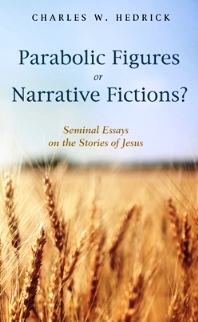
I am delighted to announce that Wipf and Stock, publishers in Eugene, Oregon, has recently published in their selective Cascade Series a new book of mine entitled Parabolic Figures or Narrative Fictions? Seminal Essays on the Stories of Jesus (Eugene OR: Cascade, 2016); the cost is $38.00 from the press. It is available at Amazon, Barnes and Noble, etc. and even in electronic form.
 
            In the book I contend that parables do not teach moral and religious lessons; they are not, in whole or part, theological figures for the church. Rather parables are realistic narrative fictions told to Judean peasants, and like all effective fiction literature the stories are designed to draw auditors (and now readers) into their story worlds where auditors and readers make discoveries about themselves by finding their ideas challenged and subverted—or affirmed, by the stories.
 
            The parables have endings but not final resolutions, because the endings raise new complications for careful readers, which require further resolution.  The narrative contexts and interpretations supplied by the evangelists constitute an attempt by the early church to bring the secular narratives of Jesus under the control of the church's later religious perspectives.  Each narrative represents a fragment of Jesus' secular vision of reality.
 
            As I began this approach to parables over twenty years ago, I found myself moving further outside the mainstream of parables scholarship, both ecclesiastical and critical. I explored a literary approach to the parables in a series of early essays that, among other things, set out what I considered the basic rationale for a literary approach to the parables of Jesus.  These early essays form the central section of the book, published in recently edited form along with previously unpublished critiques of a strictly literary approach to the parables and my response to my critics.*
 
            I have been invited by Barnes and Noble in Springfield, Missouri for a meet-the-public and book signing on October 22, 2016.  If you are in town, drop by and let's chat a bit about parables, my blog, or you could just share a bit of your own thinking with me.  I am always happy to entertain new ideas.
 
What do you think of the parables as stories for a Judean peasant audience?
 
Charles W. Hedrick
Professor Emeritus
Missouri State University
 
*adapted from the back cover of the book; used by permission of Wipf and Stock.

Friday, March 25, 2016

Parsing the Resurrection of the Christ

Christian communities in the West celebrate Easter this year on Sunday March 27, but the Easter celebration in Orthodox Christianity will not happen until May 1, 2016.  Easter, as virtually everyone in this country knows, celebrates the revivifying of the dead Christ.  At some point between 26 and 36 of the Common Era Jesus was crucified near Jerusalem (Mark 15:22; John 19:17-20) under the administration of the Romans. There are no eyewitness accounts describing either crucifixion or resurrection that are contemporary with the event. The earliest mention of the resurrection is little more than a formulaic confession, which is thought to derive from the early Palestinian Christians, some 20 years or so before Paul; he quoted the brief confession in a letter (ca 50):
 
            I have delivered to you [the Corinthian Christians] as of first importance what I also received,
            That Christ died for our sins
                        according to the scriptures,
            and that he was buried,
            and that he was raised on the third day
                        according to the scriptures,
            and that he appeared to Cephas, then to the twelve (1 Cor 15:3-5 RSV).
 
The confession is frustrating in its lack of detail.  It doesn't describe specifically what the disciples saw; did Christ appear bodily (compare, Matt 27:51-53); did they have a vision (Acts 9:10, 17), or a dream (Matt 1:20-21)?  Did they see a spirit (Luke 24:37) or a phantom (Mark 6:49)?  Perhaps they only saw his "angel" (Acts 12:15)?  The nature of the experience is conditioned by what they saw, or thought they saw.
 
            Paul himself had no personal knowledge of what had occurred earlier except for what he learned through the confessional report.  He himself claimed, however, to have had an experience similar to what is suggested by the Palestinian confession (1 Cor 15:8; Gal 1:15-16), but he does not describe this experience further (but compare another claim, 2 Cor 12:7-9).
 
            Paul's early analysis of the post-crucifixion "sighting" by the Palestinian followers of Christ finds it to be a spiritual experience, which specifically denies that the Christ was seen in some sort of bodily state (1 Cor 15:44, 50).  In short, the physical remains of the Christ had been transformed (1 Cor 15:20, 51-53), and he came forth a "life-giving spirit" (1 Cor 15:21-22, 45).
 
            Some twenty years or so after Paul, the gospel writer we call Mark in describing the origins of the gospel that his church preached (Mark 1:1) reports only that Jesus was raised (16:6); there are no reports of sightings. Only an empty tomb and the promise that he could be seen in Galilee (16:7) greeted the mourners coming to the tomb that first Easter morning; it was a terrifying experience (16:8).  Towards the end of the first century the resurrection state of the Christ has become something more substantial than a vision, dream, or bodiless spirit. In the romantic accounts of the later gospels he was described as being seen in a bodily state (Matt 28:9; Luke 24:36-43; John 20:24-29).  In the early 2nd century such statements suggesting a bodily state were seized upon to argue that "he was in the flesh even after the resurrection" (Ignatius, Smyrnaeans, 3:1-3).
 
Commentary:
 
Is the resurrection of the Christ an historical event?  A reported sighting of a dead person following his burial is not what we usually think of as an historical event—that is, as an event open to verification by a neutral third party.  The witnesses to the resurrection (Peter and the disciples, Paul, and the others he reported having seen him [1 Cor 15:6-8]) all shared faith in Jesus as the Christ, and, hence, are scarcely neutral third parties).  The historical event of Easter is that they claimed to have seen him. That they claimed to have seen him is open to historical verification. What they claimed to have seen is a part of a salvation or theological history (a history that traces out the claims of the perceived acts of God in human history).  It is not a common human experience that people are raised from the dead by the activity of God.  People that die remain dead.  Hence, it is only the claim that God has intervened in human history and performed a miracle by raising Jesus from the dead that is verifiable as historical event.  The resurrection itself is a part of a theological history.  What can be observed by anyone should not be confused with what can be seen only by a few.  In this case what the few saw they saw with the eye of faith (John 20:3-9); the many, however, see with the natural eye.
 
How do you see it?
 
Charles W. Hedrick
Professor Emeritus
Missouri State University
 
"Parsing": to sort into its component parts.
Roy W. Hoover, "Was Jesus' Resurrection an Historical Event? A Debate Statement with Commentary," The Fourth R 23.5 (September-October 2010): 5-12, 24.
Charles W. Hedrick, When History and Faith Collide. Studying Jesus (Eugene, OR: Wipf & Stock, 1999), 1-13.